Table of contents
3. Usage and impact of charging interfaces in different regions
4. Trends and challenges of charging interface standardization
●J1772 - Type 1
1.Development History: In 2001, California introduced a square plug called J1772, Type 2 To Type 1 Adapter For Ev Charging Cable which had a power of only 6.6kW. In 2008, Yazaki designed a new plug with a power of 19.2kW, which has become the standard for all US vehicles since 2010, namely the new J1772, commonly referred to as J-plug or Type 1.
2.Features and Applications: Mainly used in the North American market, and also used in parts of Asia. It has five pins and supports single-phase AC charging, suitable for Level 1 and Level 2 AC chargers. The maximum output power can reach 19.2kW, but it does not support the automatic locking system.
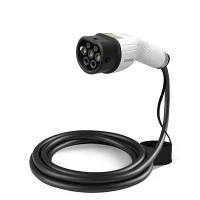
● Mennekes - Type 2
1.Development History: European cars used the Type 1 interface until major European automakers began to look for new solutions that could utilize three-phase electricity. In 2003, the Type 2 "Mennekes" plug was produced based on the IEC 62196 specification and quickly became the new European standard.
2.Features and applications: It has seven pins, supports single-phase and three-phase AC charging, and is suitable for Level 2 chargers.Ev Charging Cable Type 2 Its automatic locking function prevents the charging cable from being accidentally unplugged during charging. It is widely used in Europe, the United Kingdom, the Middle East, Africa, and Australia.
● GB/T standard
1.Development history: Developed under the supervision of the China National Standards Committee, it is the only type of charging interface currently used in China.
2Features and applications: Its AC rated voltage does not exceed 690V, frequency 50Hz, and rated current does not exceed 250A. Although the appearance is similar to Type 2, the internal cable arrangement order is opposite, and the two are incompatible.
| EV connector | CCS1 |
| Rated current | 60A-250A |
| Rated voltage | 1000VDC |
| Insulation resistance | >500MΩ |
| Contact impedance | 0.5 mΩ Max) |
| Withstand voltage | 3500V |
| Fireproof grade of rubber shell | UL94V-0 |
| Mechanical life | >10000 unloaded plugged |
| Plastic shell | thermoplastic plastic |
| Casing Protection Rating | NEMA 3R |
| Working environment temperature | -30℃- +50℃ |
| Terminal temperature rise | <50K |
| Insertion and Extraction Force | <100N |
| Warranty | 2 years |
● CCS - Type 1 and Type 2 (Combined Charging System)
1.Development history: A solution developed to achieve fast DC charging, which adds two pins to the bottom of the original Type 1 or Type 2 plug.
2.Features and applications: Type 1 is mainly used in North America, and Type 2 is mainly used in Europe. They can withstand power up to 350kW, and can unify all current charging interfaces, using one interface to complete four modes: single-phase AC charging, fast three-phase AC charging, home DC charging, and overspeed DC charging.
●CHAdeMO
1.Development history: It was jointly developed by Tokyo Electric Power Company, Nissan, Mitsubishi, and Fuji Heavy Industries, and Toyota later joined as the fifth executive member.
2.Features and applications: It is mainly used for DC fast charging in Japan and some European markets, with a maximum charging capacity of up to 50kW. It uses CAN bus as a communication interface, with high communication stability and reliability, but the connector is relatively bulky.
●Tesla dedicated interface
1.Development history: A dedicated charging interface developed by Tesla for its electric vehicles.
2.Features and applications: In North America, Tesla Supercharger uses its own two-pin charging plug, EV Charging Plug the maximum capacity of the charging socket is 120kW, the maximum current is 80A, and the charging efficiency is high. However, it is only applicable to Tesla brand vehicles and has certain limitations. However, in the Chinese market, Tesla's charging interface has been changed to the Chinese standard.
3. Usage and impact of charging interfaces in different regions
●North America
1. Main interface types: J1772 - Type 1 and CCS - Type 1 are the main ones. Almost all North American electric vehicles or plug-in hybrid vehicles (except Tesla) are equipped with Type 1 plugs, while CCS - Type 1 has become the standard for DC fast charging in North America, and most electric vehicles use this interface.
2. Impact on the market: This standardization helps to improve the compatibility and versatility of charging facilities, making it convenient for users to charge in different locations. But for Tesla owners, if they want to use public charging piles, they may need to use adapters.
● Europe
1. Main interface types: Type 2 and CCS - Type 2 are the mainstream charging interfaces in Europe. Type 2 is widely used for AC charging, while CCS - Type 2 is used for DC fast charging. Many brands, including Tesla, use Type 2 interfaces in Europe (Tesla models have slightly modified interfaces).
2. Impact on the market: Unified interface standards have promoted the development of the European electric vehicle market and made it more convenient for consumers to choose electric vehicles and charging facilities. At the same time, it is also conducive to the construction and operation of charging infrastructure and reduces costs.
●Asia
1. Main interface type: China uses the GB/T standard interface, while Japan mainly uses the CHAdeMO interface. However, in recent years, Japanese automakers have gradually turned to CCS-Type 1 for new models in the North American market. In addition, Type 1 is also used in some parts of Asia.
2. Impact on the market: China's GB/T standard interface has promoted the rapid development of the domestic electric vehicle industry and improved the compatibility and safety of charging facilities. Although Japan's CHAdeMO interface has been widely used in the past, its share in the global market may be affected to a certain extent as international standards are gradually unified.
4. Trends and challenges of charging interface standardization

●Standardization trend
With the global development of the EV Charging Cables, the trend of charging interface standardization is becoming increasingly obvious. For example, the CCS standard has been supported by more and more automakers and is expected to become one of the global unified charging standards. In addition, some international organizations and industry associations are also actively promoting the standardization of charging interfaces to improve the compatibility and versatility of global charging facilities.
●Challenges faced
1. Technical differences: There are differences in the design and technology of charging interfaces between different regions and enterprises. To achieve unified standards, technical coordination and integration are required.
2. Cost investment: The transformation of existing charging facilities and vehicle charging interfaces requires huge cost investment, which may be a challenge for some enterprises and regions.
3. Market competition: Some enterprises may be unwilling to give up existing technologies and standards for their own interests, thus bringing resistance to standardization work.
With the continuous advancement of electric vehicle technology and the continuous expansion of the market, the types of charging interfaces may become more diversified and intelligent. On the one hand, higher-power charging interfaces will continue to emerge to meet users' demand for fast charging; on the other hand, wireless charging technology is also gradually developing and may become an important charging method in the future. In addition, with the advancement of global standardization work, the compatibility and versatility of charging interfaces will continue to improve, providing electric vehicle users with a more convenient charging experience.
The diversity of electric vehicle charging interface types reflects the development status and characteristics of the global electric vehicle industry. Although there are certain differences between different regions and companies at present, the trend of standardization is unstoppable. By strengthening international cooperation and technological innovation, it is expected to achieve global unification of charging interfaces in the future and promote the healthy and sustainable development of the electric vehicle industry.