

Table of contents
2. Main types of EV charging sockets
● AC charging socket
(1.)Type 1 (SAE J1772)
(2.)Type 2 (Mennekes)
(3.)GB/T standard
●DC charging socket
(1.)CCS (Combined Charging System)
(2.)CHAdeMO
(3.)Tesla proprietary connector
3. Charging socket usage in different regions
(1.)North America
(2.)Europe
(3.)Asia
4. Development trend of EV charging socket market
(1.)Higher charging power
(2.)Intelligence and interconnection
(3.)Development of wireless charging technology
(1.) Compatibility issues
(2.) Cost pressure
(3.)Insufficient infrastructure construction
6. Industry innovation and breakthroughs
(1.)New materials and designs
(2.)Integration and multifunctionality
As the world pays more attention to environmental protection and sustainable development, the electric vehicle (EV) market is showing a rapid growth trend. As a key link in the use of electric vehicles, the development of charging sockets plays a vital role in promoting the popularity and convenience of electric vehicles. This article will explore various related information about EV charging sockets, including the main types, usage in different regions, development trends, and challenges faced.
2. Main types of EV charging sockets
●AC charging socket
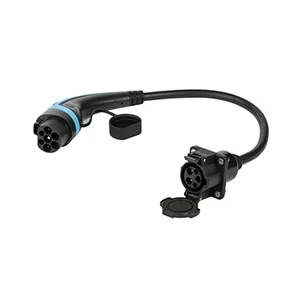
(1. )Type 2 To Type 1 Adapter For Ev Charging Cable: Mainly used in North America and parts of Asia. It has five pins, supports single-phase AC charging, is suitable for Level 1 and Level 2 AC chargers, and has a maximum output power of up to 19.2kW. This socket is simple in design and user-friendly, and is standard for many electric vehicles in the North American market.
(2.) Type 2 (Mennekes): Widely used in Europe, the United Kingdom, the Middle East, Africa, and Australia. It has seven pins, supports single-phase and three-phase AC charging, is suitable for Level 2 chargers, and has an automatic locking function to prevent the charging cable from being accidentally unplugged during charging. It supports a wide power range and can meet the charging needs of different users.
(3. )GB/T standard: It is the only type of charging interface used in China. Its rated AC voltage does not exceed 690V, the frequency is 50Hz, and the rated current does not exceed 250A. Although it looks similar to the Type 2 socket, the internal cable arrangement is opposite and the two are incompatible. This standard has strongly promoted the rapid development of China's electric vehicle industry.
| EV connector | CCS1 |
| Rated current | 60A-250A |
| Rated voltage | 1000VDC |
| Insulation resistance | >500MΩ |
| Contact impedance | 0.5 mΩ Max) |
| Withstand voltage | 3500V |
| Fireproof grade of rubber shell | UL94V-0 |
| Mechanical life | >10000 unloaded plugged |
| Plastic shell | thermoplastic plastic |
| Casing Protection Rating | NEMA 3R |
| Working environment temperature | -30℃- +50℃ |
| Terminal temperature rise | <50K |
| Insertion and Extraction Force | <100N |
| Warranty | 2 years |
●DC charging socket
(1.) CCS (Combined Charging System): It is divided into two variants: CCS1 (mainly used in North America) and CCS2 (mainly used in Europe). It adds two pins to the bottom of the original Type 1 or Type 2 plug, can withstand power up to 350kW, integrates multiple charging modes, including single-phase AC charging, fast three-phase AC charging, home DC charging and ultra-fast DC charging, and is adopted by more and more global automakers.
(2.) CHAdeMO: Developed by Tokyo Electric Power Company, Nissan, Mitsubishi and Fuji Heavy Industries, it is mainly used for DC fast charging in Japan and some European markets, with a maximum charging capacity of 50kW. It uses CAN bus as the communication interface, with high communication stability and reliability, but the connector is relatively large.
(3.) Tesla proprietary connector: Developed by Tesla for its electric vehicles. In North America, Tesla Supercharger stations use its proprietary two-pin charging plug, with a maximum capacity of 120kW and a maximum current of 80A for charging sockets with high charging efficiency. However, it is only applicable to Tesla vehicles and has certain limitations. In the Chinese market, Tesla's charging interface has been changed to Chinese standards.
3. Charging socket usage in different regions
(1.) North America
Type 1 and CCS1 are the mainstream in North America. EV Charging Plug Almost all North American electric vehicles or plug-in hybrid vehicles (except Tesla) are equipped with Type 1 plugs, while CCS1 has become the standard for DC fast charging in North America and is adopted by most electric vehicles. This standardization improves the compatibility and versatility of charging facilities, but Tesla owners may need to use an adapter when using public charging piles.
(2.) Europe
The mainstream charging interfaces in Europe are Type 2 and CCS2. Type 2 is widely used for AC charging, and CCS2 is used for DC fast charging. Many European brands, including Tesla (whose models use a slightly modified interface in Europe), have adopted the Type 2 interface. The unified interface standard has promoted the development of the European electric vehicle market, facilitated consumers to choose electric vehicles and charging facilities, and also helped to reduce the construction and operation costs of charging infrastructure.
(3.) Asia
China adopts the GB/T standard interface, and Japan mainly adopts the CHAdeMO interface. In recent years, Japanese automakers have gradually turned to CCS1 for new models in the North American market. In addition, Type 1 is also used to a certain extent in parts of Asia. China's GB/T standard interface has improved the compatibility and safety of domestic charging facilities and promoted the development of the electric vehicle industry. Although Japan's CHAdeMO interface has been widely used in the past, its global market share may be affected to a certain extent as international standards are gradually unified.
4. Development trend of EV charging socket market
(1.) Higher charging power
With the continuous advancement of electric vehicle technology, users have higher and higher requirements for charging speed. In order to meet this demand, charging sockets will develop in the direction of higher power. For example, EV Charging Cables sockets can already support 350kW charging power. In the future, higher power sockets may appear, which will greatly shorten the charging time and improve the user experience.
(2.) Intelligence and interconnection
Future EV charging sockets will be more intelligent and have the ability to communicate with vehicles and power grids. Through intelligent charging sockets, users can understand the charging status, estimated charging time and other information in real time, and can also remotely control charging. In addition, charging sockets will also be interconnected with the power grid, participate in the demand response and energy management of the power grid, and improve the operation efficiency and stability of the power grid.
(3.) Development of wireless charging technology
As an emerging charging method, wireless charging technology has the advantages of convenience and beauty, and is gradually attracting attention. Although wireless charging technology currently faces problems such as efficiency and cost, as the technology continues to mature, it is expected to be more widely used in the field of electric vehicle charging in the future. For example, some parking lots and public places may install wireless charging facilities to provide users with a more convenient charging experience.
(1.) Compatibility issues
The design and technology of charging sockets in different regions and enterprises are different, which brings inconvenience to users and restricts the cross-regional use of electric vehicles. To solve this problem, international organizations and industry associations should strengthen cooperation to promote the formulation and implementation of global unified charging socket standards. At the same time, enterprises should also actively participate in the formulation of standards to improve the compatibility of products.
(2.) Cost pressure
The development and production of high-performance and high-safety charging sockets requires a lot of R&D funds and production costs. In addition, it also costs a certain amount of money to transform and upgrade some old charging facilities. This may lead to higher prices for charging sockets and increase the cost of use for users. To reduce costs, enterprises can reduce production costs by optimizing production processes and increasing production scale. At the same time, the government can also support the construction and upgrading of charging infrastructure through policies such as subsidies.
(3.) Insufficient infrastructure construction
At present, there is still a lack of electric vehicle charging infrastructure worldwide, especially in some remote areas and old communities. This causes users to encounter situations where they cannot find charging piles or have to wait in line for a long time when charging. To solve this problem, the government and enterprises should increase the construction of charging infrastructure, rationally plan the layout of charging piles, and increase the coverage rate of charging piles. At the same time, social capital can also be encouraged to participate in the construction of charging infrastructure and jointly promote the development of the electric vehicle industry.
6. Industry innovation and breakthroughs
(1.) New materials and designs
In order to improve the performance and reliability of charging sockets, some companies are developing and using new materials. For example, materials with higher high temperature resistance and corrosion resistance are used to manufacture the outer shell and internal connectors of charging sockets to extend the service life of charging sockets. In addition, in terms of design, more attention is paid to humanization and aesthetics, making charging sockets easier to operate and integrate with the surrounding environment.
(2.) Integration and multifunctionality
The future charging sockets will develop in the direction of integration and multifunctionality. For example, the charging sockets are integrated with smart meters, energy management systems, etc. to achieve precise control of the charging process and optimized management of energy. At the same time, some other functions can also be integrated into the charging sockets, such as Wi-Fi hotspots, advertising displays, etc., to increase the added value of the charging sockets.
As an important part of the electric vehicle industry, the development of EV charging sockets is of great significance to promoting the popularization and sustainable development of electric vehicles. With the continuous advancement of technology and the continuous demand of the market, charging sockets will continue to innovate and develop to provide users with a more convenient, efficient and safe charging experience. Although there are still some challenges, through the joint efforts of the government, enterprises and all sectors of society, I believe that these problems will be gradually solved and the electric vehicle charging industry will usher in a brighter future.


