

Introduction: Global background of the charging interface standard dispute
As the global electric vehicle (EV) market enters an explosive period, the compatibility issue of charging infrastructure has gradually become the focus of the industry. At present, Type 1 (SAE J1772) and Type 2 (IEC 62196-2) are the two mainstream charging interface standards, dominating the North American/Japanese and European markets respectively. However, with the acceleration of the globalization strategy of automakers and the increase in users' demand for charging efficiency, the call for upgrading Type 1 devices to Type 2 is growing. This transformation is not only a technical adaptation issue, but also involves the interests of automakers, charging operators and policymakers.
The core difference between Type 1 and Type 2 chargers
Electrical performance:
Type 1 is single-phase AC charging, and the maximum power is usually 7.4kW; Type 2 supports three-phase AC, up to 22kW, and the charging efficiency is increased by about 300%.
Physical structure:
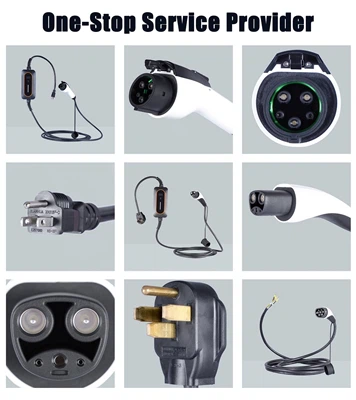
Type 1 adopts a 5-pin design and is small in size; Type 2 is a 7-pin interface, compatible with three-phase power supply and supports more communication protocols.
Market distribution:
Type 1 is dominant in North America, Japan and South Korea, while Type 2 is a mandatory EU standard and is gradually penetrating into emerging markets in Asia Pacific.
Market demand drive: Why do companies target Type 2 transformation?
Unified demands of global automakers:
European automakers such as Volkswagen and BMW face the problem of high Type 1 adaptation costs in the North American market, while Tesla has achieved multi-market coverage by providing Type 2 adapters.
User-side efficiency pain points:
Surveys show that the average charging time of Type 2 users is 40% shorter than that of Type 1, which is crucial for online car-hailing and commercial fleets.
Policy pressure:
The EU Alternative Fuel Infrastructure Regulation (AFIR) requires that new public charging piles built after 2025 must support Type 2, prompting the upstream of the industry chain to actively adjust.
Technical feasibility analysis: transformation plan and cost considerations
Hardware transformation path:
Directly replace the charging gun head and cable, the cost is about
150
−
150−300/set;
Upgrade the on-board charger (OBC) to support three-phase input, the transformation cost is as high as more than $2000.
Software adaptation challenges:
Type 2 needs to be compatible with the ISO 15118 protocol to achieve the Plug & Charge function, which poses a challenge to the communication module of old models.
The rise of third-party solutions:
For example, the Type 1 to Type 2 adapter launched by South Korea's Sparkitech, priced at $499, can temporarily solve compatibility issues.
Industry cases: actual actions of car companies and charging operators
Tesla's "flexible adaptation" strategy:
By providing a Type 2 to Type 1 adapter with the car, the hardware modification cost for entering the North American market is reduced.
IONITY's European experience:
This charging network supported by the car company alliance has increased the proportion of Type 2 from 65% in 2018 to 98% in 2023.
Emerging market game:
The Indonesian government forced public charging piles to adopt the Type 2 standard, forcing Japanese car companies to adjust their localization strategies.
The driving force of policy and standardization
The leading position of the European Union:
Through the "Charging Interface Act", Type 2 and CCS Combo 2 are bundled and promoted to form a technology-policy closed loop.
Variables in the Sino-US game:
The "Charging Compatibility Program" recently funded by the US Department of Energy is still based on Type 1, but allows third parties to certify Type 2 devices.
The role of the International Electrotechnical Commission (IEC) in reconciliation:
The IEC 63110 standard being developed attempts to integrate the communication protocols of Type 1 and Type 2 to pave the way for cross-regional compatibility.
Future trends: unification and compatibility of charging interfaces
Industry analysts predict that by 2030, the market share of Type 2 is expected to rise from the current 54% to 68%, but the possibility of completely replacing Type 1 is low. A more realistic path is:
Popularization of dual-standard compatible charging piles: For example, the Terra series launched by ABB supports both Type 1 and Type 2;
The rise of wireless charging technology: BMW i4 has achieved commercialization of wireless charging, or avoids the interface dispute from the root.
Challenges and suggestions: How do companies deal with transformation risks?
Cost sharing problem: Charging operators are unwilling to bear the transformation costs alone and need to sign long-term profit-sharing agreements with car companies.
User education is lagging behind: The survey shows that 43% of Type 1 users mistakenly believe that Type 2 is "incompatible with their own models".
Technical backup plan: While retaining the Type 1 interface, support the Type 2 communication protocol through software upgrades.
Conclusion: Can Type 2 become the global mainstream?
Although Type 2 has advantages in technology and policy, it is difficult to shake the existing market of Type 1 in the short term. The more likely situation is that regional standards and global compatibility solutions coexist. For companies, the key is to achieve flexible adaptation through modular design (such as Weilai's swappable battery interface) - after all, in the arena of electric vehicles, it is always the experience of "senseless switching" that wins users, not the shape of the interface.


