Introduction
As the annual sales of electric vehicles worldwide exceed 10 million, charging cables, as the key carrier connecting vehicles to the power grid, have a direct impact on charging efficiency and user experience through their technical standards and product types. Currently, there are many types of charging cables on the market, and the interface standards vary significantly. The industry is accelerating its evolution towards standardization and high power.
AC charging cable: the cornerstone of slow charging
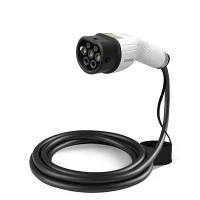
AC charging cables are mainly used for slow charging in home and public scenarios, and need to be converted from AC to DC through an on-board charger. Its power range is usually 3.7kW - 22kW. For example, it takes 6 - 8 hours for a 7kW home charging pile to fully charge a vehicle with a range of 400km. Mainstream interfaces include European Type 2 (7-pin), North American SAE J1772 (5-pin) and Chinese national standard GB/T. The national standard interface has a coverage rate of over 95% in China and is compatible with most domestic models.
DC charging cable: the main force of fast charging
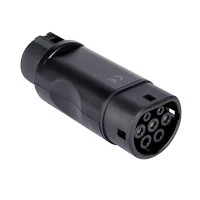
DC charging cables skip the on-board charger and directly transmit DC power to the battery to achieve rapid energy replenishment. The current mainstream power is 120kW - 350kW, and some super charging piles can reach 600kW. Taking 120kW fast charging as an example, the power can be charged from 20% to 80% in 30 minutes. International mainstream interfaces include CCS1 (North America), CCS2 (Europe) and CHAdeMO (Japan), among which CCS2 has gradually become the first choice of global car companies due to its high compatibility.
Charging cable for special scenarios
The portable charging cable can be connected to a household socket for emergency charging, with a power of 1.5kW - 3.3kW, which is suitable for short-distance travel. The wireless EV Charging Cables uses electromagnetic induction technology and does not require plugging and unplugging. It is currently mostly used in high-end models with a power of about 7kW - 11kW. Although the charging efficiency is relatively low, the convenience advantage is obvious.
Comparison of global charging cable interface standards
| Standard type | Application areas | Interface type | Maximum AC power | Maximum DC power | Representative car companies |
| Type 2/CCS2 | Europe, China (some imported models) | 7 pins (AC) + 2 pins (DC) | 22kW | 350kW+ | Volkswagen, BMW, Mercedes-Benz |
| SAE J1772/CCS1 | North America | 5 pins (AC) + 2 pins (DC) | 19.2kW | 350kW | GM, Ford |
| GB/T | China | 9 pins (AC and DC integrated) | 22kW | 600kW | BYD, NIO |
| CHAdeMO | Japan, parts of Asia | 8 pins (DC only) | - | 50kW | Nissan |
Core performance indicators of charging cables
Conductive performance determines transmission efficiency. High-quality charging cables use high-purity copper. The common cross-sectional area of AC cables is 2.5-6mm², and that of DC cables is 10-35mm². The insulation material must pass IP67 waterproof and dustproof certification and withstand high temperatures of 125°C. The mechanical strength requires more than 5,000 bending tests to ensure a service life of 5-8 years.
Industry status and market data
The global charging cable market size will reach 4.126 billion yuan in 2024 and is expected to exceed 16.5 billion yuan in 2030, with a compound annual growth rate of 26.01%. In the market competition landscape, international companies such as TE Connectivity occupy the high-end market, while domestic companies such as BYD and AVIC Optronics are rapidly rising based on their local advantages. The market share of local brands has increased to 38%.
Future development trends
The industry will focus on three major directions: high power, breaking through the 800V high-voltage platform to adapt to 1000kW supercharging; intelligence, built-in sensors to achieve real-time monitoring of temperature and current; standardization, promoting the integration of CCS and national standards, and reducing the global charging equipment adaptation cost.