

At a time when the new energy vehicle industry is booming, the charging interface, as a key link in the supply of electric energy, has a profound impact on the industry ecology through its technical types and standard specifications. Different countries and regions have different market demands and technical paths, which have spawned a variety of charging interface solutions. They have their own characteristics in physical structure, electrical characteristics and applicable scenarios, and together they have built a global charging interface technology landscape.
Content
1. Charging interface technology classification framework
2. Detailed explanation of AC charging interface technology
3. Analysis of DC charging interface technology
4. Technology evolution and market challenges
1. Charging interface technology classification framework
From the perspective of power transmission, charging interfaces are mainly divided into two categories: alternating current (AC) and direct current (DC). The AC interface uses the on-board charger to achieve power conversion, with relatively moderate power, suitable for slow charging and regular charging scenarios; the DC interface skips the on-board charger and directly transmits power to the battery pack, with higher power density, meeting the needs of fast charging. The following sorts out the mainstream charging interface types by region and technical standards:
| Interface type (AC/DC) | Name | Main application areas | Technical features |
| AC | Type 1 (J1772) | North America, Japan | Single-phase design, suitable for home and small public AC piles, compact structure |
| AC | Type 2 | Europe, some Asian markets | Supports single/three-phase electricity, strong compatibility, mainstream solution for public AC piles |
| AC | GB/T AC interface | China | Compliant with national standards, adapted to domestic AC charging networks, ensuring compatibility in the local market |
| DC | CCS (Combo 1/Combo 2) | Europe and the United States (Combo 1 corresponds to North America, Combo 2 corresponds to Europe) | Extended DC pins based on AC Type 1/Type2, achieving AC/DC integration, supporting high-power fast charging |
| DC | CHAdeMO | Japan, some Asian countries | Independent DC interface standard, early focus on high-power fast charging, widely used in Japanese car companies |
| DC | GB/T DC interface | China | National standard DC solution, adapted to domestic new energy vehicle DC fast charging needs, ensuring technical independence |
2. Detailed explanation of AC charging interface technology
Type 1 (J1772) interface
Derived from the needs of the North American market, the Type 1 interface is designed with simplicity and practicality as the core. Its physical structure is a single-phase connection with a compact pin layout. It is suitable for 120V/240V household voltage and is the standard for home charging and small public AC piles in North America. In the evolution of technology, it ensures charging safety through standardized protocols, such as grounding detection and overcurrent protection. Although the power limit is limited to a single phase (usually around 7.4kW), it meets the needs of daily slow charging scenarios and has become the basic support for the early popularization of new energy vehicles in the North American market.

The European-dominated Type 2 interface stands out with its multi-phase adaptation advantage. It supports single-phase (230V) and three-phase electricity (400V), with a power range of 3.7kW to 22kW, and is suitable for multiple scenarios such as homes and commercial parking lots. The interface design incorporates anti-misplugging, waterproof and dustproof structures to improve outdoor reliability. Driven by the European unified market, Type 2 has become the mainstream choice for public AC charging networks and has gradually penetrated into some Asian countries, demonstrating its technical compatibility and adaptability to scenarios.
GB/T AC interface
As part of China's national standard system, the GB/T AC interface is based on the characteristics of the local power grid. It standardizes the physical size, electrical parameters and communication protocols of the interface to ensure the compatibility of domestic car companies and charging pile manufacturers. It is suitable for 220V single-phase and 380V three-phase electricity, with a power range of 3.5kW - 44kW, which can meet both home slow charging (such as 7kW home piles) and commercial places. Fast charging needs of three-phase electricity. Through the implementation of mandatory standards, the GB/T AC interface has built a unified domestic AC charging ecosystem to help popularize new energy vehicles.
3. Analysis of DC charging interface technology
CCS series interface (Combo 1/Combo 2)
The birth of CCS (Combined Charging System) aims to integrate AC and DC charging needs. Combo 1 is based on the North American Type 1 interface and expands the DC pin; Combo 2 is upgraded based on the European Type 2. They realize "one gun, two modes". AC charging continues the original power. In DC mode, Combo 1 supports a maximum power of 350kW, and Combo 2 can reach or even higher power (such as some super charging piles have exceeded 300kW). Through the CAN communication protocol, the charging process is accurately controlled to adapt to the fast charging needs of lithium-ion batteries. It has become the core standard of the high-power fast charging network in the European and American markets, and has greatly promoted the efficiency of new energy vehicles.
CHAdeMO, developed by the Japanese Automakers Alliance, focuses on high-power DC fast charging. The early design targets operating vehicles such as electric buses and taxis, with a power of 50kW-100kW. Through a unique communication handshake protocol, the battery and the charging pile are intelligently matched to ensure the safety of fast charging. Driven by Japanese automakers, CHAdeMO was once widely used in the Asian market. Although it faces competition from CCS in the future, it still occupies a place in the public fast charging network of some countries (such as Japan and South Korea) due to its technological maturity, and continues to upgrade and explore higher power (such as CHAdeMO 3.0 plans to exceed 500kW power).
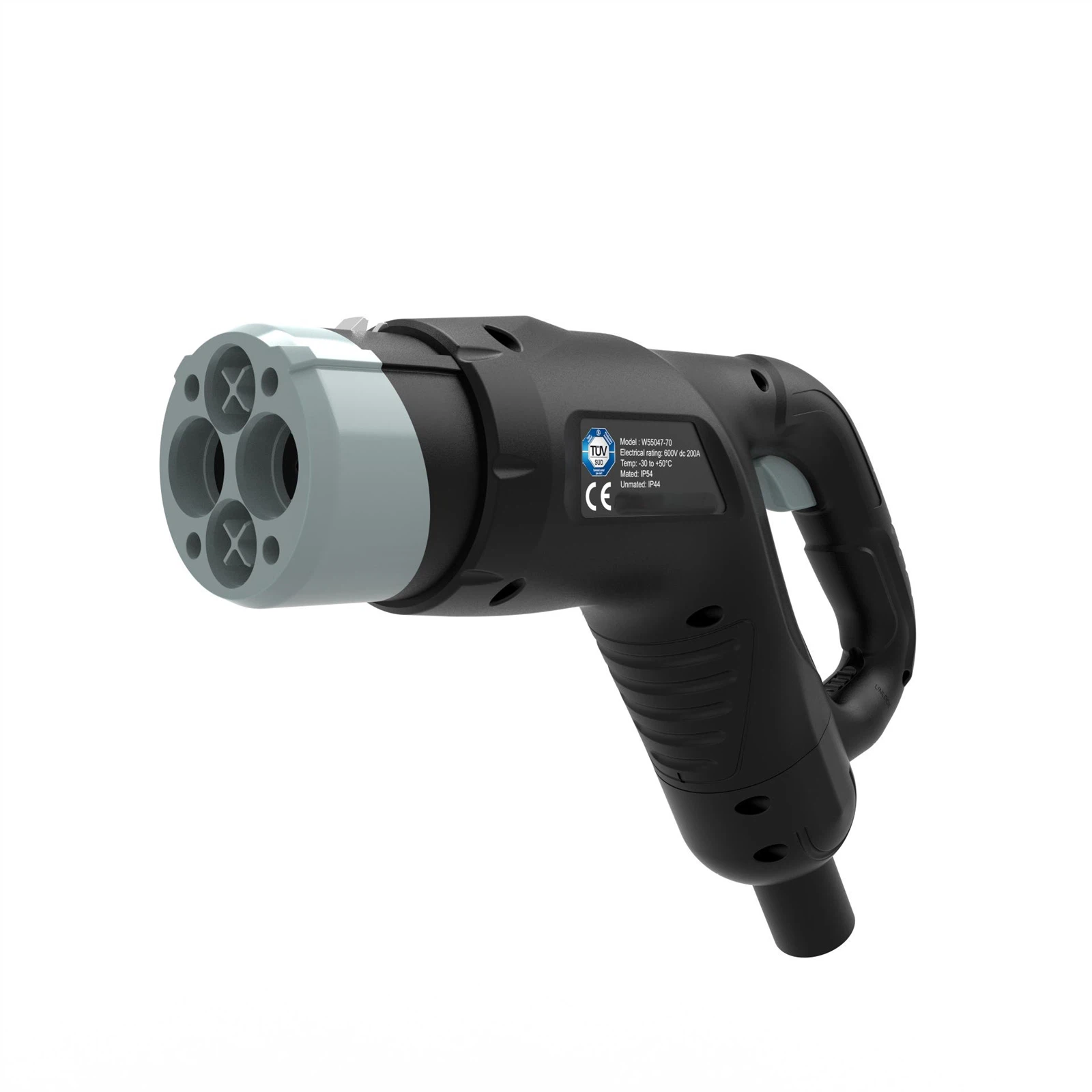
GB/T DC interface
China's national standard DC interface is a key guarantee for the local new energy vehicle industry. It defines independent DC charging communication and electrical connection standards, supports a wide power range (such as 30kW - 480kW), and adapts to the battery requirements of different models. Through the unification of national standards, domestic charging pile manufacturers and car companies collaborate to optimize and achieve a balance between charging efficiency and safety, such as adopting a flexible charging strategy to dynamically adjust the power according to the battery status, which not only protects the battery life, but also improves the energy replenishment speed. Today, the GB/T DC interface has become the mainstream solution for domestic high-speed fast charging networks (such as supercharging stations in highway service areas), supporting the energy replenishment needs of new energy vehicles for long-distance travel.
4. Technology evolution and market challenges
At present, charging interface technology shows a trend of "coexistence of integration and differentiation": integration is reflected in the exploration of multi-standard compatible solutions (such as some charging piles support CCS, CHAdeMO, GB/T multi-protocols) to adapt to global models; differentiation is due to regional market demand and technical barriers, retaining characteristic standards (such as GB/T's strong adaptability in China). But challenges also come with it. Global car companies need to adapt to multiple standard interfaces, increasing R&D costs; charging pile operators face pressure for equipment compatibility transformation, raising the construction threshold.
In the future, charging interface technology may evolve towards "ultra-high speed, full compatibility, and intelligence": on the one hand, power continues to break through (such as 1MW-level fast charging research and development), shortening the charging time; on the other hand, through intelligent identification, wireless communication and other technologies, weaken the physical interface differences and build a more convenient charging ecosystem. In this process, standard setting organizations, car companies, and energy companies need to work together to balance regional characteristics and global compatibility, and promote the new energy vehicle industry to a more efficient and inclusive stage.
From the basic guarantee of AC slow charging to the efficiency breakthrough of DC fast charging, charging interface technology is deeply embedded in the new energy vehicle industry. Understanding its type differences and evolution logic is not only related to consumers' energy replenishment experience, but also determines the development direction of the industry's globalization and intelligence. In the technological iteration and market game, only by breaking through with open collaboration can we build a new charging ecology that adapts to future travel and make new energy vehicles truly a convenient and efficient transportation carrier.


