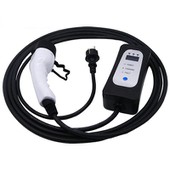
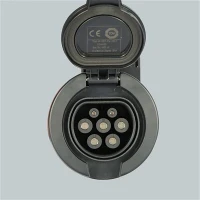
I. Core difference comparison
| Features | Type 1 charger | Type 2 charger |
| Current type | Single-phase AC | Single-phase/three-phase AC compatible |
| Power range | 1~7.5kW | 7.4~22kW (public charging pile can reach 43kW) |
| Charging speed | Slow charging (about 5-8 hours to fully charge) | Fast (5-7 times faster than Type 1) |
| Main application scenarios | Home, private garage | Public places (parking lots, shopping malls, etc.) |
| Interface standard | SAE J1772 (North America, Japan) | IEC 62196 (mainstream in Europe) |
| On-board charger requirements | Requires on-board OBC to convert AC to DC | Requires on-board OBC to convert AC to DC |
| Cost | Low | Higher (limited by power grid conditions) |
II. Detailed analysis
1. Current type and power
Type 1: Only supports single-phase AC, with a power limit of 7.5kW. For example, when using a 220V/32A power supply, the theoretical maximum power is 7kW12.
Type2: Compatible with single-phase and three-phase AC, with a wider power range. Home installations are usually 7.4kW or 11kW (three-phase), and public charging piles can reach 22kW or even 43kW (such as Tesla destination charging piles).
2. Charging speed
Type1: Taking 7kW as an example, it takes about 8.5 hours to fully charge a vehicle with a battery capacity of 60kWh, which is suitable for home charging at night.
Type2: When charging with three-phase 22kW, the same battery capacity only takes about 3 hours, significantly shortening the charging time29.
3. Interface design
Type1: Adopts a 5-pin design (2 power pins + ground + communication), mainly used in the North American and Japanese markets.
Type2: Adopts a 7-pin design, additionally supports three-phase power and control signals, is a European standard, and gradually becomes the global mainstream (such as Tesla supports Type2 after the revision).
4. Applicable scenarios
Type1: Due to its low power, it is mostly used in private homes or low-speed charging scenarios1.
Type2: Widely used in public charging networks, compatible with high power requirements, and supports vehicle networking communications (such as charging status synchronization).
5. Compatibility and standards
Type1: A converter is required to be used on Type2 piles (such as some imported models).
Type2: Supports CCS Combo standard (DC fast charging extension), and will be more compatible in the future.
III. Selection suggestions
Home users: If grid conditions permit, Type2 (11kW) can balance charging speed and cost.
Public facilities: Prioritize the deployment of Type2 high-power piles, which are suitable for most models and support future upgrades.
Tip: Some models (such as BYD) can break through the power limit of a single pile through dual-gun charging technology, achieving more efficient energy replenishment.