Introduction
With the rapid global adoption of electric vehicles (EVs), the compatibility of charging infrastructure has become a core issue that demands urgent attention. Different charging connectors are used in different countries and by different brands, posing numerous challenges for both users and infrastructure developers. This article, based on Power-Sonic's industry analysis, comprehensively reviews the major EV charging connector types worldwide and their current status, presenting the path and prospects for future mobility standardization.
Overview of Electric Vehicle Charging Methods: Differences Between AC and DC Charging Modes
EV charging methods are primarily categorized into two types: alternating current (AC) slow charging and direct current (DC) fast charging. AC slow charging uses an onboard inverter to convert AC power from the grid into DC power for the battery. DC fast charging completes the conversion at the charging station, directly supplying DC power to the vehicle's battery, significantly increasing charging speed.
Detailed Explanation of Mainstream Charging Interfaces
1.Combined Charging System (CCS)
A DC fast charging interface widely used in Europe and North America. It's based on a Type 1 (North America, Japan, and South Korea) or Type 2 (Europe) AC interface, with two high-current DC pins added to the bottom for AC/DC interoperability. With an output power of up to 350 kW and strong compatibility, it lays the foundation for the trend toward unified interfaces across multiple markets.
2.CHAdeMO
Originating in Japan, this DC fast charging standard was once popular with Japanese car brands like Nissan. Currently, there are over 57,800 CHAdeMO charging stations worldwide in 99 countries. While still in operation, they are gradually being replaced by CCS.
3.GB/T (China National Standard)
China widely uses the GB/T standard for AC and DC interfaces. The GB/T AC version has a power rating of up to 7.4 kW, while the GB/T DC version has a power rating of approximately 237.5 kW. The exterior is similar to the European Type 2, but the internal wiring sequence is different, resulting in incompatibility.
4.SAE J1772 (Type 1) and Mennekes (Type 2)
SAE J1772 (Type 1): The North American and Japanese AC slow-charging standard, supporting up to 19.2 kW (single-phase 240 V, 80 A).
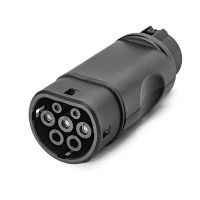
Mennekes (Type 2): A commonly used AC interface in Europe, Australia, and parts of Asia, supporting up to 7.6 kW single-phase and 22 kW three-phase. It can also be used for Tesla's shared CCS2 architecture.
5.Tesla NACS Interface (North American Charging Standard)
Introduced by Tesla in 2012, it was opened to other manufacturers in 2022 and officially standardized by the SAE in 2023. It supports integrated AC and DC charging, with a maximum power of 250 kW. Its compact design and compatibility with the Supercharger network offer significant advantages.
Interface Comparison: Speed, Compatibility, and Geographic Applicability
| Interface Type | type | Maximum power | Regional mainstream | Advantages and Current Status |
| SAE J1772(Type 1) | AC | ~19.2 kW | North America, Japan, South Korea | Widely applicable, good compatibility |
| Mennekes(Type 2) | AC | ~22 kW(Three-phase) | Europe, etc. | Higher power, European standards |
| CCS1 / CCS2 | DC(simultaneous AC) | ~350 kW | North America/Europe | High speed, integrated AC/DC |
| CHAdeMO | DC | -- | Japan, some other regions | Many network points, but gradually being replaced |
| GB/T | DC / AC | ~237 kW | China | National standards, centralized applications, poor compatibility |
| NACS | AC / DC | ~250 kW | North America (Tesla) | Miniature interface, simplified network access |
The Importance and Challenges of Interface Standardization
Unified interface standards are crucial for the widespread adoption of EVs, particularly in terms of compatibility, cost, and user experience. The trend toward standardization, exemplified by NACS, is actively promoted by both the government and industry. However, in reality, these standards still face challenges, such as long adaptation cycles for automakers, high replacement costs for legacy equipment, and regional disparities.
Conclusion: The Industry Trend Towards Standardization
Overall, despite the diversity of EV charging interfaces worldwide, CCS and NACS are gradually becoming mainstream. In the coming years, driven by policy and market adaptation, charging devices with greater compatibility and a better user experience will become mainstream. "Plug and charge" travel will significantly increase the appeal and adoption of EVs. The path to standardization of electric vehicle charging is rapidly approaching.