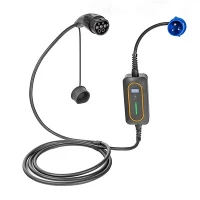
Why Charging Interface Standards Are So Important
With the rapid expansion of the electric vehicle market, charging interface standards have become a key factor influencing user experience and infrastructure development. Different interface standards not only determine vehicle-to-charger compatibility but also directly impact charging efficiency, safety, and the speed of adoption. J1772 and CCS (Combined Charging System) are currently the most representative standards in North America and some international markets. This article will delve into their differences to help the industry and users better understand their respective positioning and application prospects.
J1772 Standard: The Industry Cornerstone of AC Charging
J1772, also known as SAE J1772, was developed by the Society of Automotive Engineers (SAE) and is currently the mainstream standard for AC charging in North America. Its core features include:
- It is suitable for low- to medium-power AC charging, typically Level 1 (120V, slow charging) and Level 2 (240V, medium-speed charging).
- Wide compatibility: Nearly all electric vehicles sold in North America (except Tesla, which comes with an adapter) support J1772.
- Flexible Application Scenario: This standard is widely adopted in home garages, public parking lots, and offices.
Due to its stability and widespread adoption, J1772 has become a reliable choice for daily recharging for EV users. However, its limitation lies in its relatively slow charging speed, making it unsuitable for the rapid recharging needs of long-distance drivers.
CCS Standard: The Accelerator for DC Fast Charging
CCS, or Combined Charging System, is an expansion of J1772, adding a DC fast charging interface. Its key advantages include:
- Support for Higher Power Output: Some CCS chargers can achieve ultra-fast charging speeds of 350kW, significantly reducing recharging time.
- Compatibility: By combining a DC interface with an AC port, vehicles can simultaneously use J1772 AC charging and CCS DC fast charging.
- Application Scenario: Primarily used on highways, long-distance travel service areas, and urban fast charging stations.
This design has ushered in a "fast charging revolution" for electric vehicles, making it particularly suitable for long-distance drivers and those pressed for time, and has become a key driver of electric vehicle adoption.
Technology Comparison: Key Differences Between J1772 and CCS
Although CCS and J1772 share some ties, they differ significantly in their core functions and applications:
- Charging Type: J1772 is limited to AC charging, while CCS supports both AC and DC modes.
- Charging Speed: The maximum power of J1772 is typically around 19.2kW, while CCS can exceed 350kW.
- Plug Design: The J1772 plug is relatively simple, while the CCS plug adds two high-current DC contacts at the bottom.
- Application Environment: J1772 is more suitable for daily household and light public use; CCS targets fast-paced, long-distance travel scenarios.
These differences have led to the two forming a complementary relationship within the electric vehicle ecosystem, rather than direct substitution.
Market Trends: Will a unified standard emerge in the future?
Globally, charging interface standards present a diverse landscape:
- North American market: J1772 and CCS dominate, while Tesla maintains its independence with its own interface and adapter.
- European market: CCS Type 2 is widely adopted and is gradually becoming the unified standard promoted by the EU.
- Asian market: China primarily uses GB/T, while Japan has CHAdeMO.
Despite regional differences in standards, as multinational automakers accelerate their global expansion, the industry is increasingly calling for a unified standard. CCS, as a solution compatible with both AC and DC, is expected to gain support in more regions in the future, while J1772 is likely to continue to be used in North American home and public AC charging scenarios for a long time.
User Choice: How to Determine Which Standard is Most Suitable?
For users, choosing which interface is not entirely a matter of their own, but rather depends on the car brand and regional policies. However, understanding the differences in standards can help users plan their charging methods more effectively:
- Home scenario: If you primarily rely on garage charging, J1772 can meet most needs.
- Long-distance travel: If you frequently travel across cities or on highways, the CCS fast-charging interface can significantly reduce charging time.
- Future adaptability: As CCS infrastructure expands, choosing a CCS-compatible vehicle may offer long-term advantages.
Thus, J1772 is more of a "daily charging assistant," while CCS is a "high-speed charging tool." The coexistence of the two provides users with greater flexibility.
A dual-track development that complements rather than opposes each other.
In summary, although CCS and J1772 differ in their technical paths and application scenarios, they are not competitors in the electric vehicle ecosystem, but rather complement each other. J1772 provides users with a stable and convenient daily charging experience, while CCS promotes the development of fast-charging networks, bringing greater efficiency and freedom to electric mobility.
As the global electric vehicle market continues to grow, finding a balance among diverse standards to ensure compatibility while promoting industry unification will be a key direction for industry development in the coming years.