I. Introduction: The milestone significance of standardized charging interface
With the number of electric vehicles in North America exceeding 4 million (as of 2023), the compatibility of charging infrastructure has become a core issue in the industry. As a charging interface certified by SAE international standards, the J1772 plug not only solves the early "charging island" problem, but also promotes the scale effect of the home charging market through unified technical specifications. Its compatibility with more than 90% of public charging piles and home devices in the United States directly reduces the cost of users purchasing a second charging pile, becoming a key driver of electrification popularization.
II.Historical evolution and technical advantages of J1772
Technical iteration path
First generation standard in 2001: supports single-phase AC, maximum charging power of 7.4kW
Rev 1 upgrade in 2009: introduces two-pin communication protocol, compatible with DC fast charging precursor
SAE J1772-2017 in 2017: strengthens safety locking mechanism, supports intelligent load balancing
Core design breakthrough
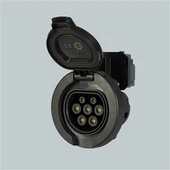
Five-contact safety architecture: through L1/L2 (live wire), N (neutral wire), ground wire and communication contacts, realizes real-time data interaction between charging pile and vehicle BMS (battery management system)
Temperature monitoring system: embedded thermal sensor can automatically cut off power when contact resistance increases abnormally
Ergonomic improvement: rotary locking mechanism reduces plug-in and pull-out force by 40%, and the success rate of one-handed operation for female users is increased to 98%
III. Full industry compatibility: worry-free charging solution for non-Tesla models
List of mainstream models
Brand Representative models Maximum charging power
General Motors Chevrolet Bolt EV 11.5kW
Ford Mustang Mach-E 19.2kW
Hyundai Kia Group IONIQ 5/EV6 10.9kW
Volkswagen Group ID.4 11kW
High-cost-effective home charging pile recommendation
EVduty-50: Canadian CSA certification, stable output in -40℃ extreme cold environment
Wallbox Pulsar Plus: Through dynamic power distribution technology, multi-device parallel management is achieved
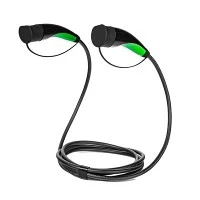
GrizzI-E Duo: Dual-gun head design supports charging of two electric vehicles at the same time
IV. Tesla adaptation solution: flexible charging that breaks brand barriers
Adapter technology analysis
Mechanical transfer principle: Through a programmable communication protocol conversion chip, the J1772 signal is converted into Tesla's proprietary TPN (Tesla Proprietary Network) directive
Safety certification level: UL2251 certification ensures 200A continuous current carrying capacity, IP67 protection for heavy rain and snow
Scenario-based application cases
Interstate road trip: Use the ChargePoint network to fill the blank area of super charging stations
Multi-brand family: A single charging pile meets the mixed use needs of Tesla and Rivian
Emergency power replenishment: Compatible with third-party J1772 slow charging piles such as hotels/shopping malls
V. Home charging ecology: from basic equipment to intelligent management
System components
Hardware layer: includes load management center, power metering module and Wi-Fi/4G communication unit
Software platform: supports time-of-use electricity price optimization (such as PG&E EV2-A rate), photovoltaic energy storage linkage, and charging carbon footprint tracking
User value proof
The practice of a family of three in California shows:
Through the valley charging strategy, the annual electricity bill is saved by $420
After linkage with solar panels, charging carbon emissions are reduced by 72%
The remote reservation function keeps the vehicle SOC (power) at the travel threshold
VI. Future Outlook: How Standardization Accelerates Electrification Transformation
According to Bloomberg New Energy Finance, the North American home charging station market will reach $24 billion by 2030. The continued evolution of the J1772 standard will focus on:
Bidirectional charging integration: support V2H (vehicle to home) emergency power supply
Supercharge compatibility expansion: 350kW fast charging through the CCS Combo interface
AI predictive charging: automatically generate the optimal charging curve based on travel big data
This revolution driven by standardization is reshaping the entire value chain from car manufacturers, power grids to end users. When compatibility is no longer a source of anxiety, consumers' choice of electric vehicles will truly return to the product itself - and this may be the most profound legacy left by J1772 to the industry.