

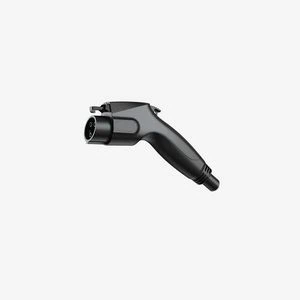
Global Standard Compatibility
Supports Type 1 (SAE J1772), Type 2 (IEC 62196), CCS1/CCS2 (Combined Charging System), CHAdeMO, Tesla NACS, and GB/T (China), covering 95% of EVs globally.
Seamlessly switches between AC charging (3.7–22 kW) and DC fast-charging (50–350 kW) to meet varying power demands.
Advanced Safety & Reliability
Integrated multi-layer protection against over-voltage, over-current, short circuits, and ground faults.
Temperature sensors and auto-throttling technology prevent overheating during high-power sessions.
IP67/IP68-rated waterproof and dustproof housing ensures operation in extreme conditions (-40°C to 60°C).
Durable & Long-Lasting Design
Constructed with industrial-grade materials: corrosion-resistant copper alloy contacts, UV-stable thermoplastic shells, and abrasion-proof cables rated for 10,000+ mating cycles.
Reinforced locking mechanisms prevent accidental disconnection in high-vibration environments.


connectors for ev charging Applications and Scenarios
Home Charging: Compact, quiet and easy-to-install connectors for garages or apartments that support overnight charging.
Public Charging Networks: High-power DC connectors for highways, malls and urban hubs that enable fast EV turnaround.
Commercial Fleets: Scalable solutions for electric buses, delivery vehicles and ride-sharing services that are reliable 24/7.
Workplace and Hospitality: Attract EV-driving customers and employees with smart, user-friendly charging stations.
Off-grid and Emergency Use: Weatherproof connectors for remote areas, disaster recovery or military operations.
FAQ
Q1: How to choose the charging cable connector suitable for different electric vehicle models?
A1: Confirm the vehicle charging interface standard:
North American models often use SAE J1772 (Type 1) or Tesla NACS.
European/Asian models mostly use Type 2 (IEC 62196) or CCS Combo 2.
Chinese vehicles are required to use the GB/T 20234 standard.
Match power requirements:
Home AC charging (AC Level 1/2) chooses 3.7–22 kW cables.
Public DC fast charging (DC Level 3) requires 50–350 kW high-power cables.
Note: Check the vehicle manual or charging port logo before purchasing to avoid compatibility issues.
Q2: What is the significance of the IP protection level of the charging cable connector? How to choose?
A2:IP level definition:
IP67/IP68: Dust and water resistant (can be immersed in water for a short time), suitable for outdoor or humid environments.
IP54: Dust and splash resistant, suitable for indoor or garage storage.
Q3: Is it normal for the cable to heat up during charging? How to prevent overheating risks?
A3: Slight heating is normal: conductor resistance will cause temperature rise when large current is transmitted (<50°C is safe).
Overheating risk control: Choose high-purity copper core + silver-plated contacts cable to reduce resistance.
Make sure the cable rated current matches the charging pile power (such as 32A cable for 7kW charging).
Avoid long-term exposure to sunlight or winding, and keep ventilation and heat dissipation.
Hot Tags: connectors for ev charging, China connectors for ev charging manufacturers, suppliers, factory, iec 62196 connector, tesla wall connector charge other cars, ccs 1 adapter, Ev Type 1, CCS 2 Plug, ev battery connectors


